
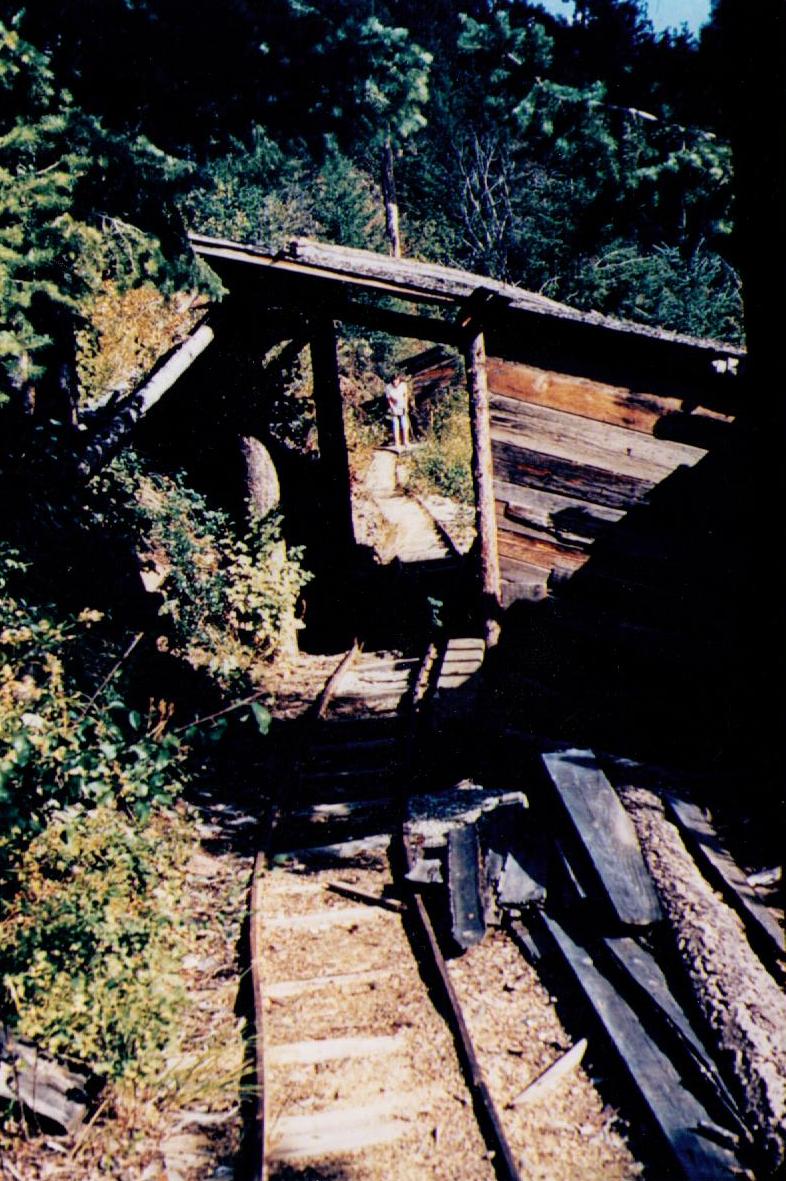
And silver, copper, lead, and zinc, and maybe even some oil. I once got a research request involving a hotel at Sanca in the mid-1890s. My first thought was that it probably had some connection to the gold rush at that community, and that was enough to get me completely sidetracked – again.
In 1895 and 1896, prospectors made promising mineral strikes in the area of White Grouse Mountain, about twenty-five miles and two mountain summits east of Kootenay Lake. Assays of ore samples from one of the claims showed anywhere from 10 to 35% copper, 75 to 600 ounces of silver, and up to $20 in gold per ton of ore.
News of these strikes triggered a rush to get to the brand-new town of Sanca, the jumping-off point to the White Grouse district. By June of 1896, there was a cluster of miners’ shacks, a general store, two hotels, and a sternwheeler landing. Charles Moore, who surveyed the townsite, later recalled that there were approximately 1,500 people living there. The Spokesman Review of July 1, 1898 indicated that there were 500 mines around White Grouse Mountain, and the Kootenaian of Kaslo trumpeted, in March 1898, that,
“It has for several years been a matter of general knowledge that large bodies of mineral abound in that region, the development of which has been delayed for want of transportation facilities; but now that the near completion of the Crows Nest Pass Railway, and the probability that a branch line will be built to White Grouse, together with the excellent prospects of the wagon road to the lake being completed, insures an easy outlet for the vast quantities of ore.”
A closer look suggests that the Sanca boom was finished months before that optimistic article appeared. Fully a year earlier, in March of 1897, the Kootenaian published a few mining notes from Pilot Bay, which included the little tidbit that “Mr. Blanchard has gone to Sanca to open his hotel, which has been closed since the collapse of the Sanca boom.”
So the Sanca gold rush couldn’t have lasted much more than a year – eighteen months at the outside. The branch railway was never built, and those “large bodies of ore” are probably still there. But the predicted wagon road (or at least a well-developed trail) between Sanca and the mines undoubtedly did exist, and is, quite probably, the foundation for the dirt road that still goes into the area today.
Sanca, though, was not the only place nearby where rich mineral claims were found. Announcements of other valuable strikes show up occasionally in regional newspapers. In June 1898, the Kootenaian reported two. One was discovered on Goat Creek about thirteen miles from Pilot Bay, by Arthur Phillips. It was a five-foot-wide ledge, and samples were assaying at 171 ounces of silver, 12% copper, and $12 in gold – rich enough that, according to the newspaper, “Arthur and his partners are feeling pretty good” over it.

The other strike was made about nine miles northeast of Porthill. “The ore is free milling and very rich,” reports the Kootenaian, “samples assaying 2,900 ounces in silver and 27 ounces (not dollars) of gold. Over fifty men have outfitted there this season and the surrounding country will be well prospected. The district lies close to the Crows Nest Pass line and should it develop according to present indications will prove to be a most valuable acquisition to southern Kootenay’s mining interests.”
There’s more of that optimism for a brilliant future that never actually came to pass. But, given the number of rich strikes in the area, perhaps that optimism wasn’t so very misplaced, after all. Here’s another, reported in the Spokesman Review in August, 1898. It relates to a community called Goat River Crossing – probably the point where the CPR tracks cross the Goat River, in Kitchener:
“This report may be the first of a number to follow relative to the mining interest in this section. The writer has just been informed of an excellent strike made not over two miles from here by Jay Wilhelms, who had been inspired to go to the Klondike, but in making a start was induced to try his luck on Goat River.” With a ledge of gold fifteen feet wide, and assaying $28 per ton in gold, silver, and copper, Jay Wilhelms was no doubt pretty satisfied with his decision not to go north.
With all the excitement about gold, silver, and other valuable ores, it’s not surprising that news about other subterranean riches might command little attention. Then, too, the demand for oil would probably have been much lower than it is today, which might explain why the Nelson Miner of April 2, 1898, treated this little announcement as somewhat of an afterthought:
“R. Morrison of Kuskanook is inspecting a petroleum field, discovered last winter by T. Ryan, about eighty miles from Kuskanook. The [Kuskanook] Searchlight says that samples will be sent to Nelson to be analyzed and if they come up to expectations a company will be formed to develop the property. The Crows Nest Pass railway passes through the petroleum belt.”
Unfortunately, the scrapbook that contains all of these newspaper clippings only goes up to the middle of 1898. It doesn’t have anything further to say about that petroleum field or any of the other promising strikes made in the area. Presumably, they shared the fate of the Sanca mines: either not as rich as first believed, too small to be worth developing, or simply too remote and isolated to make development feasible, they were abandoned and are now merely fading scratch marks on the mountainside.
Note: Old mine shafts are very dangerous places – if you find one, do not go into it. Many of the old mining claims around the area are on private property; you cannot just walk in and help yourself!